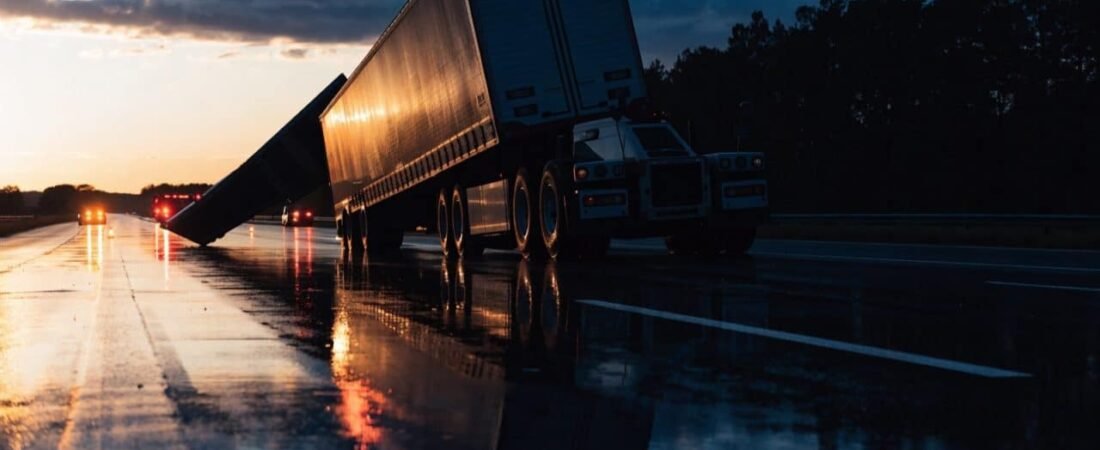
A jackknife accident occurs when a truck’s trailer swings out to the side, forming a right angle with the cab — similar to a folding pocketknife.
Common causes include sudden braking, especially on wet or icy roads, speeding, driver inexperience, and mechanical issues with the trailer’s brakes.
Why they’re so dangerous: A jackknifing trailer can span multiple lanes, striking nearby vehicles or causing a chain-reaction pileup.
Determining liability often hinges on why the jackknife occurred. If the driver was speeding or following too closely, the driver and possibly the trucking company may be liable. If a mechanical failure caused it, a maintenance contractor or parts manufacturer could share fault.
Evidence that matters: Weather conditions at the time, brake maintenance records, the truck’s speed via black box data, and witness accounts of the driver’s behavior beforehand.
Because jackknife accidents often involve multiple vehicles, cases can become complicated quickly, making early evidence preservation especially important.
Underride and Override Truck Accidents Explained
Underride and override accidents are among the most severe types of truck collisions due to the mismatch in vehicle height.
Underride accidents happen when a smaller vehicle slides underneath a truck’s trailer, often during a rear-end or side-impact collision. These can cause catastrophic injuries because the trailer can crush the passenger compartment.
Override accidents occur when a truck rides up and over a smaller vehicle, typically in a rear-end collision where the truck fails to stop in time.
Safety equipment matters. Federal regulations require rear underride guards on most trailers, and side underride guards are increasingly discussed as a safety improvement, though not universally required.
Liability considerations often include whether required underride guards were present, properly maintained, and functioning, in addition to standard questions about driver conduct and following distance.
Why these cases are serious: Because of the severity of injuries involved, these cases often include claims against the trailer manufacturer if equipment failure contributed to the outcome, in addition to the driver and trucking company.
Rollover Truck Accidents: What Victims Should Know
Truck rollovers happen when a truck tips onto its side or roof, often due to a high center of gravity combined with sudden maneuvers.
Common causes include taking curves too fast, sudden lane changes, improperly loaded or overloaded cargo, tire blowouts, and overcorrecting after drifting off the road.
Cargo plays a major role. Top-heavy or unevenly distributed loads significantly increase rollover risk, which is why cargo securement rules exist under federal regulations.
Who might be liable: The driver (for speed or maneuvering), the trucking company (for scheduling pressure or inadequate training), or a loading company (for improper cargo securement).
Injuries from rollovers can be severe for both the truck driver and occupants of nearby vehicles struck during the rollover or its aftermath.
Evidence to look for: Cargo manifests and loading records, tire condition and maintenance logs, and the truck’s speed and steering data leading up to the crash.
Rollover cases often require careful reconstruction to determine exactly what triggered the loss of control.
Rear-End Collisions With Semi-Trucks
Rear-end collisions are among the most common type of truck accident, but fault isn’t always as straightforward as it seems.
When the truck rear-ends another vehicle, common causes include following too closely, driver fatigue, distraction, or failure to account for the truck’s longer stopping distance.
When a truck is rear-ended, the smaller vehicle’s driver may be at fault — but exceptions exist, such as if the truck stopped suddenly and unnecessarily, or lacked proper brake lights or reflective markings.
Stopping distance matters. Fully loaded trucks require significantly more distance to stop than passenger vehicles, which is a key factor in determining whether a driver acted reasonably.
Comparative negligence may apply if both drivers contributed to the crash, which can affect how compensation is calculated depending on state law.
Key evidence: Following distance data from black boxes, brake light and taillight functionality, and witness accounts of speed and traffic conditions before impact.
Because rear-end truck accidents are common, insurers sometimes assume automatic fault against the rear vehicle — but a full investigation can reveal a more complete picture.
Truck Tire Blowout Accidents
A tire blowout on a commercial truck can cause the driver to lose control instantly, often leading to serious accidents.
Common causes include underinflation, overloading, worn tread, extreme heat, and manufacturing defects.
Why blowouts are dangerous: A blown tire, especially on a steering axle, can cause sudden swerving, rollovers, or jackknifing before the driver can react.
Debris hazards. Even when a blowout doesn’t directly cause a crash, tire debris (“road gators”) left on highways can cause secondary accidents for other drivers.
Determining liability often involves reviewing tire maintenance and inspection records. Trucking companies are required to conduct regular inspections, and failure to do so can support a negligence claim. If a defect caused the blowout, the tire manufacturer may also be liable.
Evidence to preserve: The tire itself (if possible), maintenance logs, inspection reports, and any prior complaints about tire condition.
Blowout cases often require an inspection of the physical tire remains, so acting quickly to preserve this evidence is especially important.
Lost Load and Cargo Spill Accidents
When cargo isn’t properly secured, it can fall from a truck and cause accidents for other drivers — sometimes without the truck even being directly involved in a collision.
Common scenarios include debris falling into traffic lanes, cargo shifting and causing the truck to lose control, or a spilled load creating a hazard that other vehicles crash into while trying to avoid it.
Federal cargo securement rules set specific standards for how loads must be secured, and violations can serve as strong evidence of negligence.
Who can be liable: The trucking company, the driver (if they failed to inspect the load), and the company responsible for loading the cargo in the first place — which may be a separate business from the trucking company.
Unique challenges: These cases sometimes involve a “hit and run” element if the truck that dropped the cargo doesn’t stop, making identification of the responsible party more difficult.
Evidence that helps: Photos of the spilled cargo and its packaging, any placards or markings identifying the shipping company, and traffic camera footage if available.
Victims of cargo spill accidents should report the incident immediately and try to document identifying information about the truck involved, even if it doesn’t stop.
Multi-Vehicle Pileups Involving Trucks
Because of their size, trucks are frequently involved in chain-reaction, multi-vehicle accidents, which raise unique legal challenges.
How pileups typically start: A single triggering event — a sudden stop, jackknife, or loss of control — sets off a chain reaction, especially in poor visibility, heavy traffic, or bad weather.
Determining the initial cause is critical, since the vehicle or driver that triggered the pileup often bears significant liability for the resulting chain of collisions.
Multiple liable parties are common, potentially including several drivers, one or more trucking companies, and sometimes government entities if road conditions or signage contributed.
Comparative fault gets complex. With many vehicles involved, insurers for each party often try to shift blame elsewhere, making these among the most contested types of accident claims.
Why legal representation matters: Sorting out liability among numerous parties and insurers typically requires a thorough investigation, often including accident reconstruction and analysis of multiple black box data sets.
If you’re involved in a multi-vehicle pileup with a truck, documenting your specific position in the chain of events — through photos, witness contacts, and your own written account as soon as possible — can be especially valuable.